Earlier this month, Norway and the United Kingdom disclosed a weeks-long military mission to deter Russian submarines operating near undersea cables and pipelines north of the UK. These vessels reportedly mapping critical infrastructure in the North Atlantic.
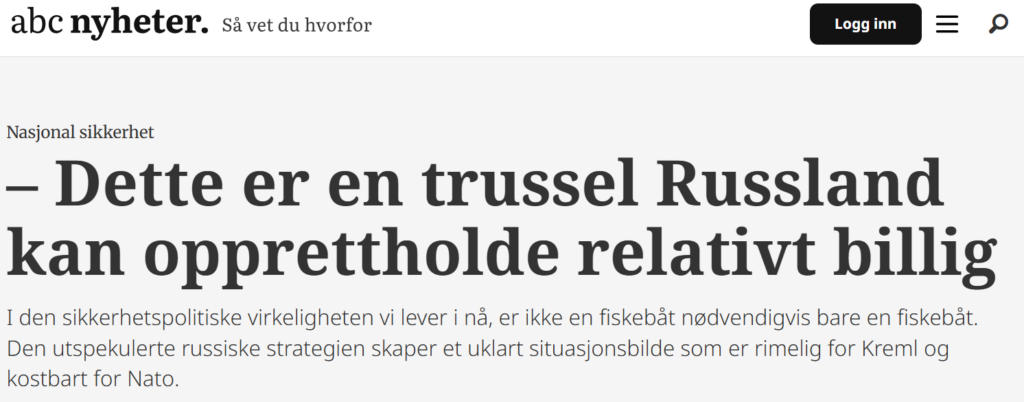
But beyond the military threat, Moscow leans on civilian assets, too. Russian fishing fleets — which can still legally dock at a handful of Norwegian ports — participate in naval shadowing, intelligence-gathering, and potentially sabotage operations. In conversation with Sigurd Nordmo, Mariia shared a few takeaways from her recent research article, “Russian Fisheries in the High North: Deterrence in the Grey Zone,” published in the March issue of the RUSI Journal.
Mariia concludes that the employment of fishing fleets for signaling may not strengthen Russian deterrence posture in any direct, cause-and-effect sense. However, it does allow Moscow to minimise its own risk and cost while maximising adversary uncertainty and defensive expenditure. By making attribution difficult and keeping operational patterns ambiguous, these vessels contribute to Russia’s strategic advantages in constraining NATO’s posture: blurring maritime situational awareness, burden operations, and complicating both policy responses and threat-scenario building for Northern European NATO states. This is, in essence, an opportunistic strategy. But it provides Russia with escalatory flexibility — and it is important to recognise these patterns.
Read the full piece: The interview with Sigurd Nordmo is available at ABC Nyheter.
The comprehensive research on this issue: “Russian Fisheries in the High North: Deterrence in the Grey Zone,” open access in the March 2026 issue of the RUSI Journal.