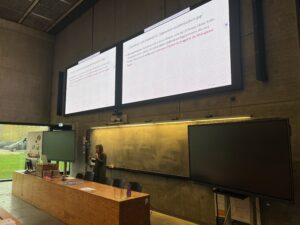
Mariia Vladymyrova speaks at the Naval Seminar at the Royal Danish Defence College

On 27 November Mariia Vladymyrova took part in the Naval Seminar “Russia’s conventional and hybrid maritime operations from the Baltic Sea to the Arctic” co-hosted by the Centre for Military Studies (University of Copenhagen), the Royal Danish Defence College and the Royal Danish Navy. The seminar brought together researchers from Denmark, Finland, Norway and Ukraine and naval officers to discuss various aspects of the Russian threat at sea. Major General Jette Albinus, Commandant of the Royal Danish Defence College, welcomed the participants, and Rear Admiral Søren Kjeldsen, Head of the Royal Danish Navy, delivered the keynote address.

Mariia Vladymyrova presented insights from her PhD research on Russian approaches to deterrence at sea in doctrine and practice along three dimensions: spatial ramifications of Russian thinking about deterrence, key trends of evolving Russian naval posture in the Baltic and the Arctic, and cross-domain rationale of Russian deterrence practice.
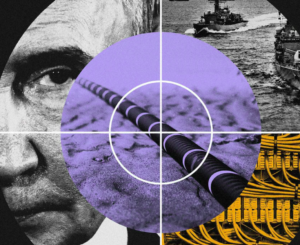
 

Mariia Vladymyrova contributes to The Telegraph’s landmark investigation into Russian fishing vessels activities in the North-Atlantic

Mariia has contributed with insights from her research on Russian fishing vessels grey zone activity and its coercive signaling rational to The Telegraph landmark investigation into suspicious patterns in the activities of Russian fishing vessels in UK waters.

The threat Russia and its proxies pose to maritime security has become multifaceted. It ranges from the environmental risks of the shadow fleet, and its tankers’ potential use as drone-launch and sabotage-by-anchor-dragging platforms, to suspicious research vessels and dangerous manoeuvres by Russian naval ships themselves, as the recent standoff with a Danish Armed Forces helicopter showed.

The fishing fleet remains a particular case. It is one of the few areas where cooperation with Russia still matters, because sustainable management of shared fish stocks requires it. Yet that same cooperation gives Russian-flagged vessels access they would otherwise not enjoy. Geography matters too: fishing grounds may coincide with sensitive seabed areas such as the GIUK gap. Or there may be no fish at all, and the access remains.

There is no clear-cut answer here beyond continued vigilance. A remainder is that Russia’s 2022 Maritime Doctrine is unambiguous: it calls for preparing transport, fishing and special-purpose vessels, for requisition, including for “special operations in peacetime”. The data from this and other investigations should push us to take this challenge more seriously, and the sanctions against Norebo show what that can look like.

Please find more details below:

Exclusive: Putin sends fishing trawlers to spy on Britain
https://www.telegraph.co.uk/news/2026/10/21/exclusive-putin-sends-fishing-trawlers-to-spy-on-britain/


Image credit: The Telegraph.

Mariia Vladymyrova discusses Russian deterrence in the grey zone with ABC Nyheter (Oslo)

Earlier this month, Norway and the United Kingdom disclosed a weeks-long military mission to deter Russian submarines operating near undersea cables and pipelines north of the UK. These vessels reportedly mapping critical infrastructure in the North Atlantic.

But beyond the military threat, Moscow leans on civilian assets, too. Russian fishing fleets — which can still legally dock at a handful of Norwegian ports — participate in naval shadowing, intelligence-gathering, and potentially sabotage operations. In conversation with Sigurd Nordmo, Mariia shared a few takeaways from her recent research article, “Russian Fisheries in the High North: Deterrence in the Grey Zone,” published in the March issue of the RUSI Journal.

Mariia concludes that the employment of fishing fleets for signaling may not strengthen Russian deterrence posture in any direct, cause-and-effect sense. However, it does allow Moscow to minimise its own risk and cost while maximising adversary uncertainty and defensive expenditure. By making attribution difficult and keeping operational patterns ambiguous, these vessels contribute to Russia’s strategic advantages in constraining NATO’s posture: blurring maritime situational awareness, burden operations, and complicating both policy responses and threat-scenario building for Northern European NATO states. This is, in essence, an opportunistic strategy. But it provides Russia with escalatory flexibility — and it is important to recognise these patterns.

Read the full piece: The interview with Sigurd Nordmo is available at ABC Nyheter.

The comprehensive research on this issue: “Russian Fisheries in the High North: Deterrence in the Grey Zone,” open access in the March 2026 issue of the RUSI Journal.