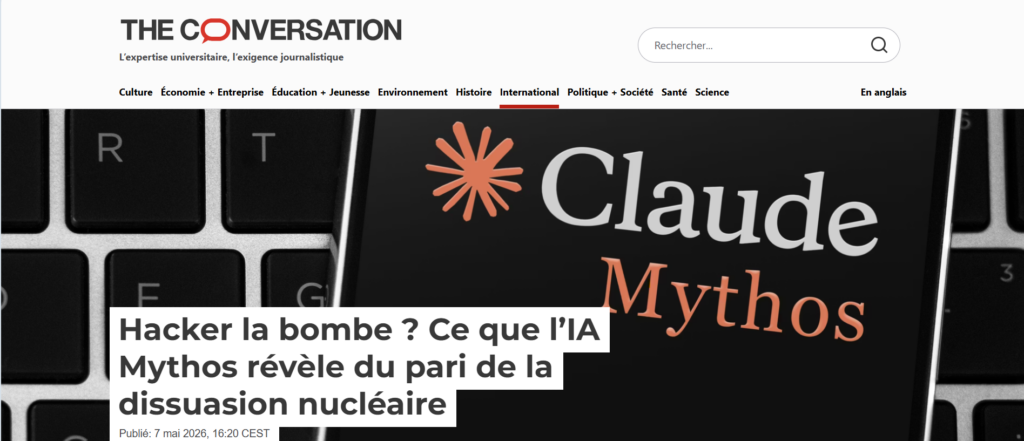
Hacker la bombe ? Ce que l’IA Mythos révèle du pari de la dissuasion nucléaire
7 May 2026
Op-ed in The Conversation France
Fraise, Thomas. “Hacker la bombe ? Ce que l’IA Mythos révèle du pari de la dissuasion nucléaire (To Hack the bomb? What Mythos IA reveals about the nuclear deterrence gamble)”, The Conversation France, May 7th, 2026, doi: https://doi.org/10.64628/AAK.awp597wau
Read more
Special Forum ‘Ritual Action in World Politics’ published in the Global Studies Quarterly (OUP)
Maria Mälksoo • 31 March 2026
The team of ERC Ritual Deterrence and the extended academic family of the project have published a Special Forum entitled ‘Ritual Action in World Politics’ in vol 6, no. 1 (January issue) of the International Studies Association’s fully open access journal Global Studies Quarterly, published by Oxford University Press. The forum was guest edited by Maria Mälksoo.
The Special Forum comprises of 13 articles:
- Maria Mälksoo (University of Copenhagen): The Logic of Ritual Action in International Relations,
Read more
What’s Critical for a Critical Take on NATO in These Times of Trouble?
Mälksoo, Maria. Conclusion: What’s Critical for a Critical Take on NATO in These Times of Trouble?, in Critical Perspectives on NATO: Feminist Insights, edited by Sorana-Christina Jude and Katharine A. Wright, pp. 212-221. Bristol: Bristol University Press. © The Author (2026) DOI: https://doi.org/10.2307/jj.32726781.17
What kind of critical perspectives on NATO do we need at the time when Russia has thrown down the gauntlet and demanded the Alliance to return to its pre-1997 boundaries shortly before launching its large-scale war against Ukraine? What emancipations would NATO benefit from in these times of troubles, along with those not prepared to destine it to the bin of Cold War legacies?
Maria Mälksoo • 19 March 2026
Russian Fisheries in the High North: Deterrence in the Grey Zone
Vladymyrova, Mariia. Russian Fisheries in the High North: Deterrence in the Grey Zone, The RUSI Journal 171 (2), pp. 1-13. © The Author (2026) DOI: https://doi.org/10.1080/03071847.2026.2638132
Russian fishing fleets are engaged in covert and overt activities in the High North. Mariia Vladymyrova argues that they serve as instruments of strategic deterrence and coercive signalling. By leveraging ambiguity and dual-use capabilities, Russia blurs the line between civilian and military operations, complicating NATO’s maritime situational awareness and demanding adaptive countermeasures in an evolving security environment.
Mariia Vladymyrova • 19 March 2026
A Show of Force: The Ritualization of Russian Strategic Posturing in the Baltic Sea
Vladymyrova, Mariia. A Show of Force: The Ritualization of Russian Strategic Posturing in the Baltic Sea, Global Studies Quarterly 6(1) (Special Forum: Ritual Action in World Politics, guest editor: Maria Mälksoo), pp. 1-14. © The Author (2026) DOI: https://doi.org/10.1093/isagsq/ksag012
This article studies military exercises as tools of strategic posturing, understood here as physically embodied, spatially configured, and visually defined coercive signaling action which commonly entails symbolic attributes. By identifying the modalities of ritualization involved in the conduct of military exercises, the article unfolds how these modalities render military activity a politically meaningful action and contribute to the construction of the displayed capabilities as credible deterrent. I argue that the spatial emplacement of strategic posturing is a key element for credibility in general deterrence. This proposition is empirically grounded in the examination of Russian naval exercises in the Baltic Sea in the years 2022–2025. The analysis accentuates how Russian strategic posturing engaged spatiality to project and sustain credibility vis-à-vis NATO as the security tensions between two actors increasingly manifest in the maritime domain.
Mariia Vladymyrova • 13 March 2026
Rituals in Nuclear Statecraft: Conjuring Conformity, Cohesion, and Cooperation
Egeland, Kjølv. Rituals in Nuclear Statecraft: Conjuring Conformity, Cohesion, and Cooperation, Global Studies Quarterly 6(1) (Special Forum: Ritual Action in World Politics, guest editor: Maria Mälksoo), pp. 1-11. © The Author (2026) DOI: https://doi.org/10.1093/isagsq/ksag017
Nuclear statecraft is often seen as a field of policy characterized by hyper-rationality and icy reserve. Yet the practices that make it up are shot through with symbolic imagery and ritualistic behavior. Seeking to advance the nascent literature on ritual in world politics, this article offers an investigation into the origins and functions of central rites in nuclear policy practice. Arguing that rituals can help conjure conformity, cohesion, and cooperation in contexts where credibility is scarce and preferences are at loggerheads, I explore how rituals are deployed to overcome key problems in nuclear statecraft, including the challenge of maintaining obedience throughout the nuclear chain of command, the imperative of securing international buy-in for controversial policies, and the difficulties associated with facilitating structured communication between adversarial states. To do so, I examine three empirical cases: Russian nuclear deterrence practice, NATO’s Nuclear Planning Group, and multilateral nuclear disarmament diplomacy at the UN.
Kjølv Egeland • 13 March 2026
Ritualized Coordination in the PLA Rocket Force: Nuclear Deterrence, Control, and Sacrifice
Hunter, Cameron. Ritualized Coordination in the PLA Rocket Force: Nuclear Deterrence, Control, and Sacrifice, Global Studies Quarterly 6(1) (Special Forum: Ritual Action in World Politics, guest editor: Maria Mälksoo), pp. 1-12. © The Author (2026) DOI: https://doi.org/10.1093/isagsq/ksag018
This article analyzes how China’s People’s Liberation Army Rocket Force (PLARF) uses ritual-like practices to convey specific political messages, around Party control of nuclear weapons and soldiers’ willingness to die for the state. The PLARF has a politically challenging mission, not only to meet the expectations of credible deterrence of its political masters in the Communist Party, but also in the eyes of its adversaries abroad. Consequently, it is insufficient for the PLARF to simply state their willingness to use nuclear weapons. Drawing on the work of Religious Studies scholar Catherine Bell, this article argues that ritualization builds staid policy statements into something reassuring to Chinese elites. Official doctrine calls for the choreographed display of weapons and troops, emphasizing their abilities but crucially also their loyalty to the Party and willingness to sacrifice themselves. To theorize how ritualized practices become politically successful, I turn to the sociologist Randall Collins. Using his interaction ritual chain framework, I argue that rituals produce the shared emotional energy required to agitate troops. PLARF leaders attempt to create symbols and meanings that overspill the immediate scene of the ritual and encounter the domestic and international audiences they target for messaging. Considering ritualizations relating to solidarity, symbolic repair, and sacrifice, this article demonstrates the PLARF addresses multiple goals and audiences with different kinds of ritual-like practices.
Cameron Hunter • 12 March 2026
The Magicians of Nuclear Strategy: Ritualized Knowledge Production and the Origins of Strategic Nuclear Thought
Fraise, Thomas. The Magicians of Nuclear Strategy: Ritualized Knowledge Production and the Origins of Strategic Nuclear Thought, Global Studies Quarterly 6(1) (Special Forum: Ritual Action in World Politics, guest editor: Maria Mälksoo), pp. 1-11. © The Author (2026) DOI: 10.1177/001083672412543
In the 1950s, a new intellectual figure emerged in American strategic debates: the nuclear strategist. Drawn largely from the RAND Corporation, these thinkers—such as Bernard Brodie, Albert Wohlstetter, and Thomas Schelling—constructed a new field of knowledge: nuclear strategy. While their direct influence on U.S. war planning remains debated, this article argues that the nuclear strategists’ primary impact lay in their ability to create a structured discourse that rendered nuclear deterrence intelligible and actionable. Building on works in epistemic and ontological security, this article conceptualizes deterrence theory as a “script,” an action-oriented construct that transforms unverifiable effects into perceived certainty and provides actors with a sense of control over events. Through ritualized knowledge production, nuclear strategists addressed the radical uncertainty of nuclear policy, acting as “magicians” who linked cause and effect by reference to the deterrence script. This article takes the oft-made comparison between these strategists and “wizards” seriously and shows how their epistemic authority was indeed grounded in relation to magic. Those actors possessed the magicians’ features—liminality, esoteric craft, and secrecy—and were engaged in a practice similar as the one of magicians: sealing over the uncertainties of high-risk activities. The combination of these features granted them with unique epistemic authority over a consequential field of knowledge. In doing so, those “magicians” made the practice of nuclear deterrence sensible, and thus possible.
Thomas Fraise • 26 February 2026
The Logic of Ritual Action in International Relations
Mälksoo, Maria. The Logic of Ritual Action in International Relations, Global Studies Quarterly 6(1) (Special Forum: Ritual Action in World Politics, guest editor: Maria Mälksoo), pp. 1-13. © The Author (2026) DOI: 10.1177/00108367241254307
International politics abounds with rituals, but the rationale for ritual action has not been systematically expounded in international theory. This introduction to the special forum on Ritual Action in World Politics invites the scholars and students of International Relations (IR) to take ritual seriously. Flagging ritual action as an underappreciated, yet politically consequential genre of action in international relations, I make two main contributions. First, the paper conceptualizes ritual action in relation to the existing rational and constructivist theories of social action. I probe the rationality, functionality, and performativity of ritual(ized) conduct vis-à-vis the logics of consequences, appropriateness, practice/practicality, and habit in international relations. I argue that ritual action seeks to navigate uncertainty and mediate ambiguity in international relations by its promise to create enchantment effects. Second, the paper relates ritual to the already sedimented IR conceptual universe of practices, rules, norms, and performances, and provides a modular framework for the forum contributions to engage with. The forum’s collective aim is to: (1) consolidate the conceptualization of international rituals, (2) deepen the evolving conversation on the features, forms and logic of ritual action in different empirical realms of world politics, and (3) outline a novel research agenda in the well-trodden subfields of deterrence, diplomacy and knowledge production in IR.
Maria Mälksoo • 24 February 2026
NATO Pirates in the Baltic Sea? Lawfare in Russian Deterrence Strategy
Mariia Vladymyrova • 20 February 2026
The chapter “NATO Pirates in the Baltic Sea? Lawfare in Russian Deterrence Strategy” explores how lawfare has become integral to Russia’s coercive signaling strategies.
Read more