Mariia Vladymyrova delivers a brief with Q&A on Russian Evolving Naval Deterrence Posture in the Arctic

Russian Interests in the Arctic: The Northern Sea Route – YouTube
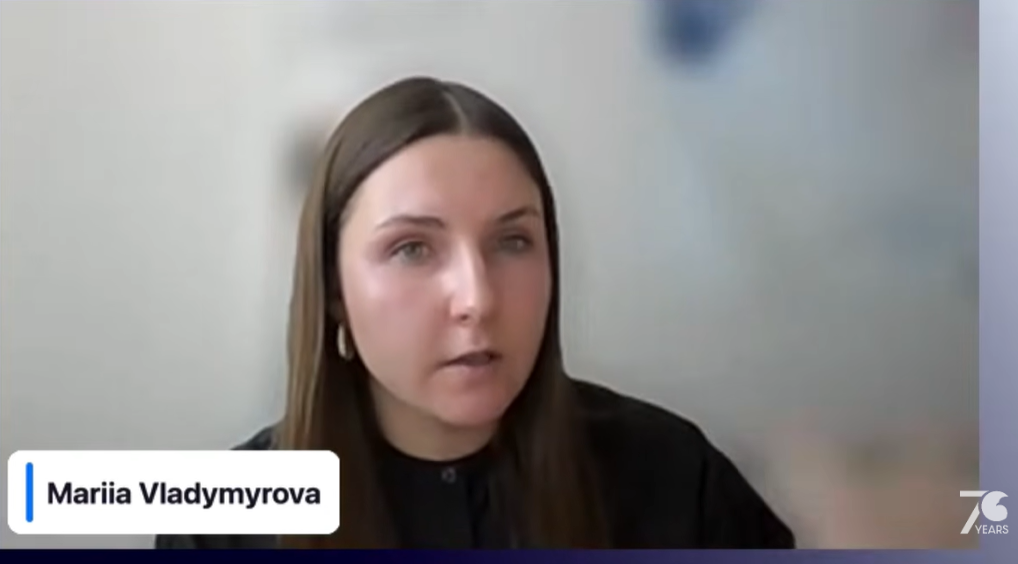
On 31 March, Mariia presented her recent research on the Northern Sea Route (NSR) legal regime as an exemplary instance of Russia’s use of lawfare as a tool of coercive signalling in the Arctic.
In conversation and Q&A with Dr. Emily J. Holland, Director of the Eurasia Program at the Foreign Policy Research Institute, Mariia argued that the current legal regime enacted in 2023 along with Russia’s 2022 Maritime Doctrine — which explicitly prioritises enforcing control over foreign naval activity along the NSR — was an early and underappreciated indicator of a broader shift in Russia’s naval deterrence posture.

That shift, she argued, is best understood not as a reaction to any single development, but as part of a long-horizon, holistic state-society effort — characteristic of how Russia approaches grand strategy more broadly. The Arctic simultaneously serves as Russia’s pre-eminent military-strategic rear, its principal energy resource and export base, and a symbol of national power and prestige. That fusion is intentional, and the NSR sits at its centre. This logic is now made explicit by Russia’s newly announced Trans-Arctic Transport Corridor (TATC). While officially framed in economic terms — connecting industrial, agricultural, and energy hubs to global consumer markets via a shorter and sanctions-resistant route — the project reveals a deeper military-strategic rationale.

Finland and Sweden’s accession to NATO has worsened the strategic outlook for protecting ballistic missile submarine operations from the Kola Peninsula, accelerating the dispersion of forces across the Arctic marginal seas and elevating the Pacific Fleet’s role in strategic deterrence. The NSR legal regime is an integral part of this architecture: by asserting that key straits constitute internal waterways — in defiance of UNCLOS — and by creating regulatory tripwires around unauthorised transit, Russia converts legal ambiguity into strategic ambiguity. Some Russian legal scholars have gone further, arguing that unauthorised transit could constitute an act of aggression, or that Russia could lawfully close the Kara Sea to foreign navigation in retaliation for Western sanctions.

Within the TATC, the NSR serves as the critical connector — binding Siberia’s major river systems and rail networks into a unified infrastructure that is as much military as it is commercial. The announced modernisation of the White Sea-Baltic Canal, taken alongside the recent deployment of modern missile corvettes on Lake Ladoga, points to the on-going integration of the Baltic and the Arctic into a single operational space, with brown-water non-strategic deterrent capabilities build-up potentially underway. The corridor, in other words, is not only an answer to Western sanctions — it equally outlines the countours of an ambitious circumpolar deterrence posture. Russia’s strategy in the Arctic is undergoing a fundamental shift, which can be described as evolving away from the Kola-centred bastion model and toward reaslisation of a Eurasian grand strategy vision.

For NATO, Mariia concluded, understanding Russia’s deterrence comprehensively is an imperative of credible response. Along with military-strategic developments, it is important to keep a big picture in mind – whereas legal frameworks have become an instrument of escalation control in as much as military signalling.

Special Forum ‘Ritual Action in World Politics’ published in the Global Studies Quarterly (OUP)

The team of ERC Ritual Deterrence and the extended academic family of the project have published a Special Forum entitled ‘Ritual Action in World Politics’ in vol 6, no. 1 (January issue) of the International Studies Association’s fully open access journal Global Studies Quarterly, published by Oxford University Press. The forum was guest edited by Maria Mälksoo.

The Special Forum comprises of 13 articles:

  1. Maria Mälksoo (University of Copenhagen): The Logic of Ritual Action in International Relations, https://doi.org/10.1093/isagsq/ksag014
  2. Jorg Kustermans (University of Antwerp): Is Ritual a Useful Resource? Instrumental and Non-Instrumental Interpretations of Ritual Action, https://doi.org/10.1093/isagsq/ksag013
  3. Kjølv Egeland (NORSAR): Rituals in Nuclear Statecraft: Conjuring Conformity, Cohesion, and Cooperation, https://doi.org/10.1093/isagsq/ksag017
  4. Cameron Hunter (University of Copenhagen): Ritualized Coordination in the PLA Rocket Force: Nuclear Deterrence, Control, and Sacrifice, https://doi.org/10.1093/isagsq/ksag018
  5. Mariia Vladymyrova (University of Copenhagen): A Show of Force: The Ritualization of Russian Strategic Posturing in the Baltic Sea, https://doi.org/10.1093/isagsq/ksag012
  6. Amir Lupovici (Tel Aviv University): The War in Ukraine: Deterrence, Rituals, and Ontological Security, https://doi.org/10.1093/isagsq/ksag016
  7. Andrew R. Hom (University of Edinburgh): Ritual Wartiming in Russia’s Three-day Special Military Operation, 2022-2025: “Everyone Must Feel Mobilized”, https://doi.org/10.1093/isagsq/ksag020
  8. Vanessa F. Newby (Monash University) and Chiara Ruffa (Sciences Po, Paris): Rituals without Rapprochement? Managing Hostility at the Tripartite Meetings in the United Nations Mission in Lebanon, https://doi.org/10.1093/isagsq/ksag019
  9. Juha A. Vuori (University of Turku): Review as Ritual: Maintaining and Disrupting Nuclear Deterrence through the Treaty on the Non-Proliferation of Nuclear Weapons Review Process, https://doi.org/10.1093/isagsq/ksag021
  10. Thierry Balzacq (Sciences Po, Paris): Diplomatic Order: The Problem of Ritual Efficacy in International Relations, https://doi.org/10.1093/isagsq/ksag023
  11. Thomas Fraise (University of Copenhagen): The Magicians of Nuclear Strategy: Ritualized Knowledge Production and the Origins of Strategic Nuclear Thought, https://doi.org/10.1093/isagsq/ksag015
  12. Christian Bueger (University of Copenhagen): Sites of Ritualized Practice: Observations from Multi-National Military Gatherings and Naval Symposiums, https://doi.org/10.1093/isagsq/ksag022
  13. Dorothy Noyes (Ohio State University): Ritual and the Life of International Orders, https://doi.org/10.1093/isagsq/ksag024

RITUAL DETERRENCE team at the ISA 2026 in Columbus, Ohio, USA, 22-25 March 2026

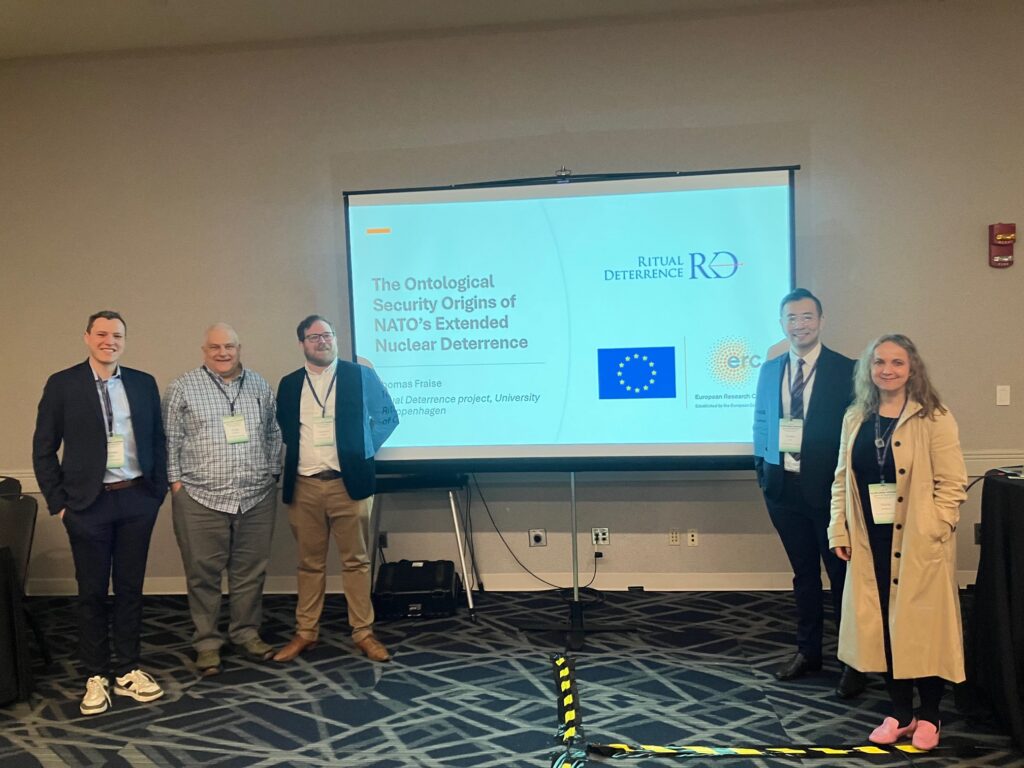
The RITUAL DETERRENCE team attended the International Studies Association’s 67th Annual Convention in Columbus, Ohio, USA in 22-25 March 2026. In the project-convened panel “The Ritual Politics of Deterrence”, Maria Mälksoo, Cameron Hunter and Thomas Fraise presented their work in progress.

Maria Mälksoo also served as a discussant for two panels (“Constructing Enemies and Allies: Identity, Discourse, and Strategic Relationships”; “Ontological Security and Identity in Fragmented Societies”) and represented the Review of International Studies at the panel dedicated to RIS’s latest Special Issue “International Politics of Cultural Heritage” alongside the session on “Publishing in Leading Journals: Meet the Editors”.

Cameron Hunter served as a discussant for the panel “Nuclear Strategy: Theory and Practice” and further presented a paper on “Ideologies of Utopian Nuclear Managerialism and the Prospect of Emancipation”.

Cameron Hunter and Thomas Fraise convened, chaired and discussed the panel “Political Theory by Default: An Exploration of the Ideology-Technology Nexus in the 21st Century”. Thomas further presented a paper “The nukes made me do it: nuclear threat making and the production of unaccountability”.

The team also held a workshop to discuss the work in progress with the project international advisory board members at the Mershon Center for International Security Studies at the Ohio State University on 24 March 2026, with Profs Dorothy Noyes, Jennifer Mitzen, Tarak Barkawi, and Jared Rabinowitz in attendance.


Maria Mälksoo participated at the International Expert Group on Peace for Ukraine meetings in Tokyo

Prof. Mälksoo participated at the International Expert Group on Peace for Ukraine meetings in Tokyo, Japan on 26-29 January 2026. The meetings were held at Keio University, Japan’s Ministry of Foreign Affairs, Japan Institute of International Affairs, National Institute of Defense Studies, and Japan International Cooperation Agency.

The focus of the working group meeting was on the questions of occupied territories, justice for Ukraine and accountability for Russia.


Maria Mälksoo presented at the symposia at Hokkaido University, Sapporo and Waseda University, Tokyo, December 2025

Prof. Maria Mälksoo presented her work in progress on contested peacetiming in Ukraine at the Slavic-Eurasian Research Center 2025 Winter International Symposium ‘Great Power Competition and the Survival of Small and Middle Powers: Perspectives from Eurasia and Beyond’ at the Hokkaido University, Sapporo, Japan on 4 December 2025. The full symposium programme is available here.

She gave another presentation on memory-political deterrence à la Russe at the international Workshop ‘Justice and National Interests in a Shifting World Order: Against the Backdrop of the Russo-Ukrainian War’ at Waseda University, Tokyo, Japan on 7 December 2025. The programme of this event is available here.

Maria Mälksoo at the ‘European Deterrence in the Third Nuclear Age’ Workshop, 19-21 November 2025

Prof. Mälksoo participated in the workshop ‘European Deterrence in the Third Nuclear Age’ at Cumberland Lodge, Windsor Great Park, UK on 19- 21 November 2025. The workshop was organised by the ERC Third Nuclear Age Project and the Institute for Peace Research and Security Policy at the University of Hamburg.

The workshop brought together 30 academics and policy practitioners working on nuclear and conventional deterrence issues across Europe for discussions and a European deterrence simulation game.


Cameron Hunter comments on China’s space debris incident for Al Jazeera News

In the past week, China’s crewed space program experienced an incident involving a small piece of space debris. The capsule used to return the astronauts was damaged, and so the mission directors took the decision to keep the crew in orbit while an alternative plan was put into action.

Dr Cameron Hunter was asked by Al Jazeera news to comment on the unfolding story, and was featured on the news segment. The item is available to watch here: https://www.youtube.com/watch?v=TJd7eKYaoYA.

Cameron Hunter at the EU Non-Proliferation and Disarmament Consortium Conference

Dr Cameron Hunter contributed to the EU’s Non-Proliferation and Disarmament Consortium Conference held in Brussels. He chaired a panel on ‘East Asia’s Strategic Landscape: Power Dynamics and Regional Dialogue’, bringing together experts from China, Japan and Australia.

The UN, NATO, IAEA, European Commission, EEAS and many thinktanks were all represented at the conference.

Maria Mälksoo’s invited lecture ‘The Baltic Way of Deterrence’ in the Indiana University Inner Asian and Uralic National Resource Center lecture series ‘Security across Central Eurasia in the 21st Century: From the Baltic Sea to the Mongolian Steppe’

Prof. Maria Mälksoo gave an invited talk ‘The Baltic Way of Deterrence’ in the Indiana University Inner Asian and Uralic National Resource Center (IAUNRC) lecture series ‘Security across Central Eurasia in the 21st Century: From the Baltic Sea to the Mongolian Steppe’ on 12 November 2025 on Zoom.

This lecture focused on the Baltic ways of practicing deterrence since Russia’s annexation of Crimea: notably in shaping NATO’s deterrence posture in the alliance’s eastern flank, on the one hand, and through the diplomatic pursuits for post-war accountability for Russia and justice for Ukraine, on the other.

Maria Mälksoo featured in the Exciting Minds Exhibition by the Estonian Research Council

Prof. Maria Mälksoo and the RITUAL DETERRENCE project are featured in the exhibition ‘Exciting Minds’, initiated by the Estonian Research Council, and featuring the researchers from Estonia who have been awarded grants by the European Research Council (ERC).

See here.