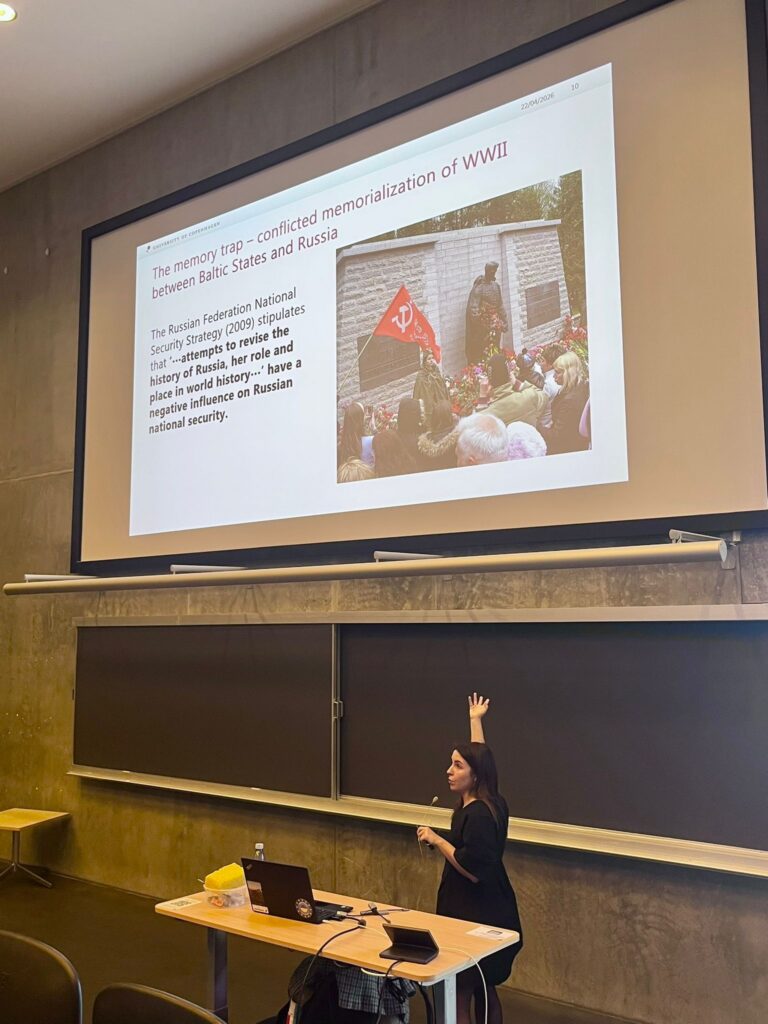
Mariia Vladymyrova delivers a guest lecture at the University of Southern Denmark


Mariia Vladymyrova delivered a guest lecture on Baltic security to students at the University of Southern Denmark. Her talk addressed the gaps in how public and policy discourse currently assesses the region, aiming to reframe the hybrid threat environment in the Baltics not as a standalone phenomenon, but as a symptom of a broader shift in Europe’s political landscape triggered by the Russian assertive restorationism.
Throughout the lecture, Mariia introduced students to the foundational tenets of deterrence and escalation, highlighting how these frameworks offer a useful lens for examining Baltic security from the early 2000s through to the present day. By tracing the evolution of these dynamics between NATO and Russia over two decades, she encouraged students to think critically about the structural drivers behind today’s security challenges in the region. The session sparked engaging discussion and underscored the importance of bringing nuanced, framework-driven analysis into conversations about European security.

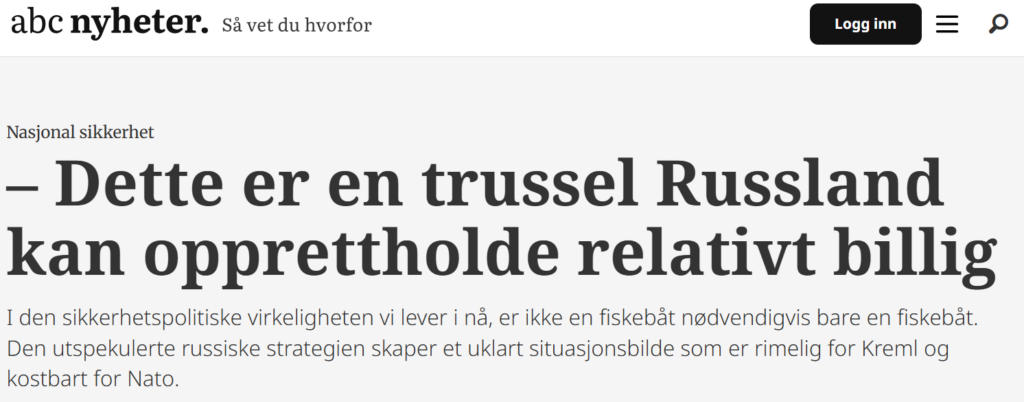
Mariia Vladymyrova discusses Russian deterrence in the grey zone with ABC Nyheter (Oslo)

Earlier this month, Norway and the United Kingdom disclosed a weeks-long military mission to deter Russian submarines operating near undersea cables and pipelines north of the UK. These vessels reportedly mapping critical infrastructure in the North Atlantic.

But beyond the military threat, Moscow leans on civilian assets, too. Russian fishing fleets — which can still legally dock at a handful of Norwegian ports — participate in naval shadowing, intelligence-gathering, and potentially sabotage operations. In conversation with Sigurd Nordmo, Mariia shared a few takeaways from her recent research article, “Russian Fisheries in the High North: Deterrence in the Grey Zone,” published in the March issue of the RUSI Journal.

Mariia concludes that the employment of fishing fleets for signaling may not strengthen Russian deterrence posture in any direct, cause-and-effect sense. However, it does allow Moscow to minimise its own risk and cost while maximising adversary uncertainty and defensive expenditure. By making attribution difficult and keeping operational patterns ambiguous, these vessels contribute to Russia’s strategic advantages in constraining NATO’s posture: blurring maritime situational awareness, burden operations, and complicating both policy responses and threat-scenario building for Northern European NATO states. This is, in essence, an opportunistic strategy. But it provides Russia with escalatory flexibility — and it is important to recognise these patterns.

Read the full piece: The interview with Sigurd Nordmo is available at ABC Nyheter.

The comprehensive research on this issue: “Russian Fisheries in the High North: Deterrence in the Grey Zone,” open access in the March 2026 issue of the RUSI Journal.

Cameron Hunter and Thomas Fraise present at the UK DAAA Conference

Dr Cameron Hunter and Dr Thomas Fraise recently attended the UK Deterrence and Assurance Academic Alliance (DAAA) conference, hosted by King’s College London. Dr Hunter presented research from his recent publication in the RITUAL DETERRENCE special issue of Global Studies Quarterly, as well as early findings from work in progress. The panel was masterfully chaired by Dr Jan Ruzicka of Aberystwyth University.

Dr Fraise, with co-author Sterre van Buuren, presented their critique of the “nuclear IQ” concept, provoking a spirited debate among the panellists and audience.

Cameron Hunter undertakes fieldwork in Taiwan

Dr Cameron Hunter recently returned from several weeks of fieldwork in Taiwan, under the auspices of the RITUAL DETERRENCE project. The data collected supports several of his ongoing research work packages and opened up new possibilities for analysis.

Taiwan is the main target of the People’s Republic of China’s 21st strategic goals for the 21st century. Utilising a mixture of data collection methods, Dr Hunter’s research sought to clarify the character of China’s deterrence/coercion practices in, around, and over Taiwan. This included direct and participant observation of daily life in Taiwan, particularly during Chinese military drills; interviews with experts and practitioners; social media data, and fieldwork on the “red beaches” likely to be used in the event of a Chinese invasion.

Dr Hunter would like to thank all of the participants and colleagues in Taiwan that assisted during the fieldwork, and for their continuing support.

Mariia Vladymyrova delivers a brief with Q&A on Russian Evolving Naval Deterrence Posture in the Arctic

Russian Interests in the Arctic: The Northern Sea Route – YouTube

On 31 March, Mariia presented her recent research on the Northern Sea Route (NSR) legal regime as an exemplary instance of Russia’s use of lawfare as a tool of coercive signalling in the Arctic.
In conversation and Q&A with Dr. Emily J. Holland, Director of the Eurasia Program at the Foreign Policy Research Institute, Mariia argued that the current legal regime enacted in 2023 along with Russia’s 2022 Maritime Doctrine — which explicitly prioritises enforcing control over foreign naval activity along the NSR — was an early and underappreciated indicator of a broader shift in Russia’s naval deterrence posture.

That shift, she argued, is best understood not as a reaction to any single development, but as part of a long-horizon, holistic state-society effort — characteristic of how Russia approaches grand strategy more broadly. The Arctic simultaneously serves as Russia’s pre-eminent military-strategic rear, its principal energy resource and export base, and a symbol of national power and prestige. That fusion is intentional, and the NSR sits at its centre. This logic is now made explicit by Russia’s newly announced Trans-Arctic Transport Corridor (TATC). While officially framed in economic terms — connecting industrial, agricultural, and energy hubs to global consumer markets via a shorter and sanctions-resistant route — the project reveals a deeper military-strategic rationale.

Finland and Sweden’s accession to NATO has worsened the strategic outlook for protecting ballistic missile submarine operations from the Kola Peninsula, accelerating the dispersion of forces across the Arctic marginal seas and elevating the Pacific Fleet’s role in strategic deterrence. The NSR legal regime is an integral part of this architecture: by asserting that key straits constitute internal waterways — in defiance of UNCLOS — and by creating regulatory tripwires around unauthorised transit, Russia converts legal ambiguity into strategic ambiguity. Some Russian legal scholars have gone further, arguing that unauthorised transit could constitute an act of aggression, or that Russia could lawfully close the Kara Sea to foreign navigation in retaliation for Western sanctions.

Within the TATC, the NSR serves as the critical connector — binding Siberia’s major river systems and rail networks into a unified infrastructure that is as much military as it is commercial. The announced modernisation of the White Sea-Baltic Canal, taken alongside the recent deployment of modern missile corvettes on Lake Ladoga, points to the on-going integration of the Baltic and the Arctic into a single operational space, with brown-water non-strategic deterrent capabilities build-up potentially underway. The corridor, in other words, is not only an answer to Western sanctions — it equally outlines the countours of an ambitious circumpolar deterrence posture. Russia’s strategy in the Arctic is undergoing a fundamental shift, which can be described as evolving away from the Kola-centred bastion model and toward reaslisation of a Eurasian grand strategy vision.

For NATO, Mariia concluded, understanding Russia’s deterrence comprehensively is an imperative of credible response. Along with military-strategic developments, it is important to keep a big picture in mind – whereas legal frameworks have become an instrument of escalation control in as much as military signalling.