Cameron Hunter provides analyses of space weaponry and AI

In October, Cameron Hunter appeared on the Angry Planet podcast again, this time to discuss the news that the American military announced it had space-based weapons for the first time. He appeared alongside his co-author, Dr Bleddyn Bowen (University of Durham). The episode can be accessed here: https://open.spotify.com/episode/3RdxcGxgcsbT8qgx9HyTVO?si=XcIS4sJ_QnC7iI3huFwC6w


At the end of the month, Cameron also contributed to SIPRI’s Online Dialogue on “AI Opportunities for Strategic Stability”. The session was held under the Chatham House rule.

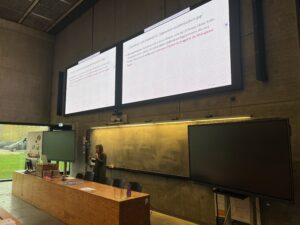
Thomas Fraise delivers a Keynote at the 2026 Northern Security Dialogue

Thomas Fraise delivered a keynote at the 2026 Northern Security Dialogue, held at the Folketing in Copenhagen on November 7. His presentation dealt with issues related to deterrence and disarmament in the Nordic region’s current predicament.

The conference was organized by Nordic YATA chapters and Natonuoret.

Mariia Vladymyrova at the 16th Maritime Security Dialogue: Strategy and Military Mobility in the North and the Baltic Sea in Berlin (SWP)

On 3 November 2026 Mariia presented insights from her PhD research at the 16th Maritime Security Dialogue: Strategy and Military Mobility in the North and the Baltic Sea, organised by Stiftung Wissenschaft und Politik (SWP).

The discussion focused on matters of naval strategy and mobility adaptation in the High North/Arctic and the Baltic Sea, and what are the gaps in how we understand Russia’s evolving maritime activities and naval force posture in these regions.

Mariia contributed her assessment on the Kremlin’s evolving maritime posture in the Baltic Sea: the re-establishment of Leningrad Military District but also Trans Arctic Transport Corridor point that Russia is moving towards treating the Baltic and the Arctic as one North-Western strategic direction. Moscow appears to have concluded that a regional conflict is now a realistic prospect. For now, though, it has to keep tensions in the Baltic low, because its war economy depends heavily on the region’s ports and energy facilities. The rhetoric shifts between nuclear threats, grey-zone actions and an emphasis on freedom of navigation. That pattern is Russian deterrence par excellence: a continuous, cross-domain effort to shape the strategic environment, rather than a linear choice between dissuasion and escalation.

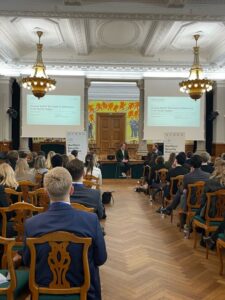
Mariia Vladymyrova speaks at the Naval Seminar at the Royal Danish Defence College

On 27 November Mariia Vladymyrova took part in the Naval Seminar “Russia’s conventional and hybrid maritime operations from the Baltic Sea to the Arctic” co-hosted by the Centre for Military Studies (University of Copenhagen), the Royal Danish Defence College and the Royal Danish Navy. The seminar brought together researchers from Denmark, Finland, Norway and Ukraine and naval officers to discuss various aspects of the Russian threat at sea. Major General Jette Albinus, Commandant of the Royal Danish Defence College, welcomed the participants, and Rear Admiral Søren Kjeldsen, Head of the Royal Danish Navy, delivered the keynote address.

Mariia Vladymyrova presented insights from her PhD research on Russian approaches to deterrence at sea in doctrine and practice along three dimensions: spatial ramifications of Russian thinking about deterrence, key trends of evolving Russian naval posture in the Baltic and the Arctic, and cross-domain rationale of Russian deterrence practice.