Maria Mälksoo and Thomas Fraise at the EISA PEC2026 in Lisbon, 1-4 September 2026

Maria Mälksoo and Thomas Fraise participated in the European International Studies Association’s 19th Pan-European Conference at the ISCTE – University Institute of Lisbon, Portugal on 1-4 September 2026.

Maria Mälksoo co-convened a pre-conference workshop with Dr Andrew Hom (University of Edinburgh) and Dr Lauren Rogers (University of Leuven) on ‘Ritual Times of War and Peace’ (with 13 participants). She also spoke at two book roundtables (on Mirko Palestrino’s Military Victory Beyond the Battlefield, Oxford University Press 2025 and Dorothy Noyes and Tobias Wille’s edited volume on Exemplarity in World Politics, Bristol University Press 2025).

Together, Maria Mälksoo and Thomas Fraise presented their respective work in progress at the panel ‘Temporal politics of catastrophe: War, climate and competing visions of survival’. Maria’s paper was entitled ‘Ritual Endtiming as International Ordering’ and Thomas’s ‘Apocalyptic World-Ordering: The Logic of the Liberal International Order’.

Thomas Fraise also featured his paper ‘Nuclear Deterrence as Ontological Security: The Origins of NATO’s Extended Nuclear Deterrence’, chaired a panel ‘Martial Materialities of Environmental Devastation’, and presented his paper (co-authored with Sterre Van Buuren and Benoît Pelopidas) ‘The Climate Security Costs of the New Nuclear Arms Race’.


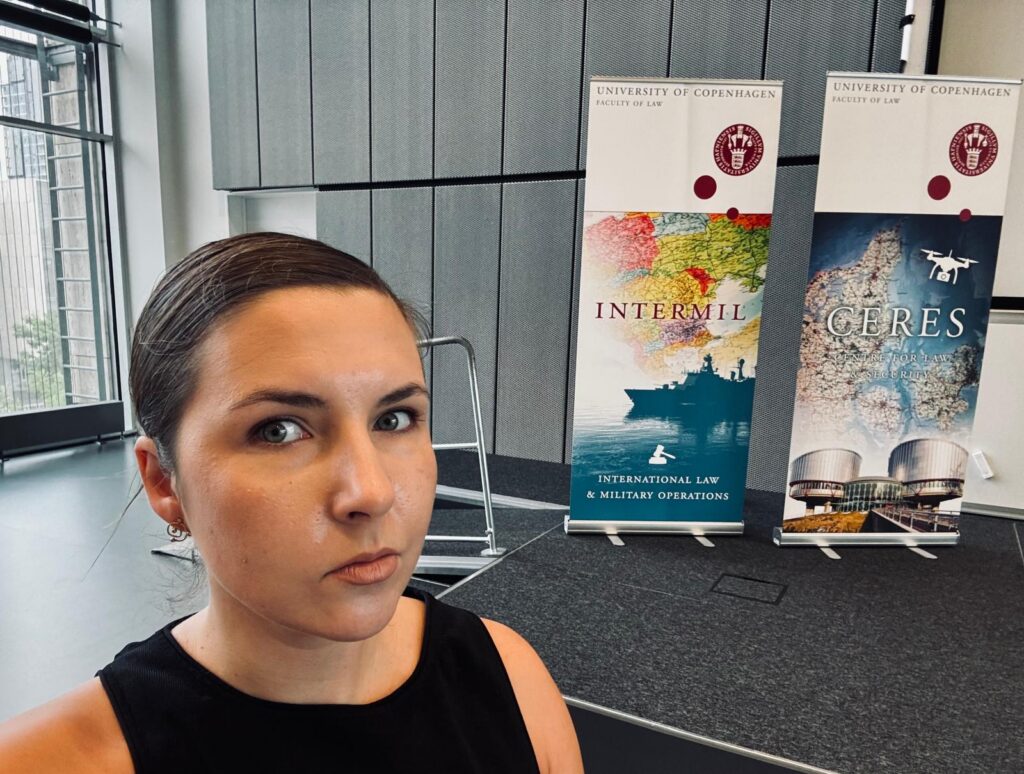
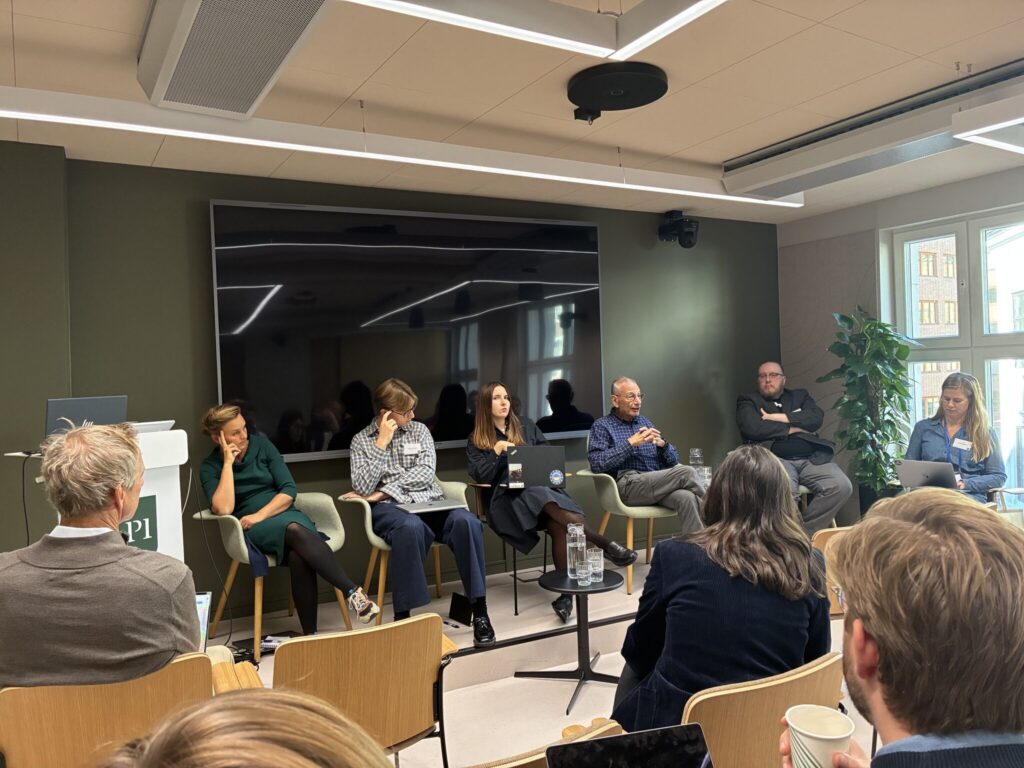
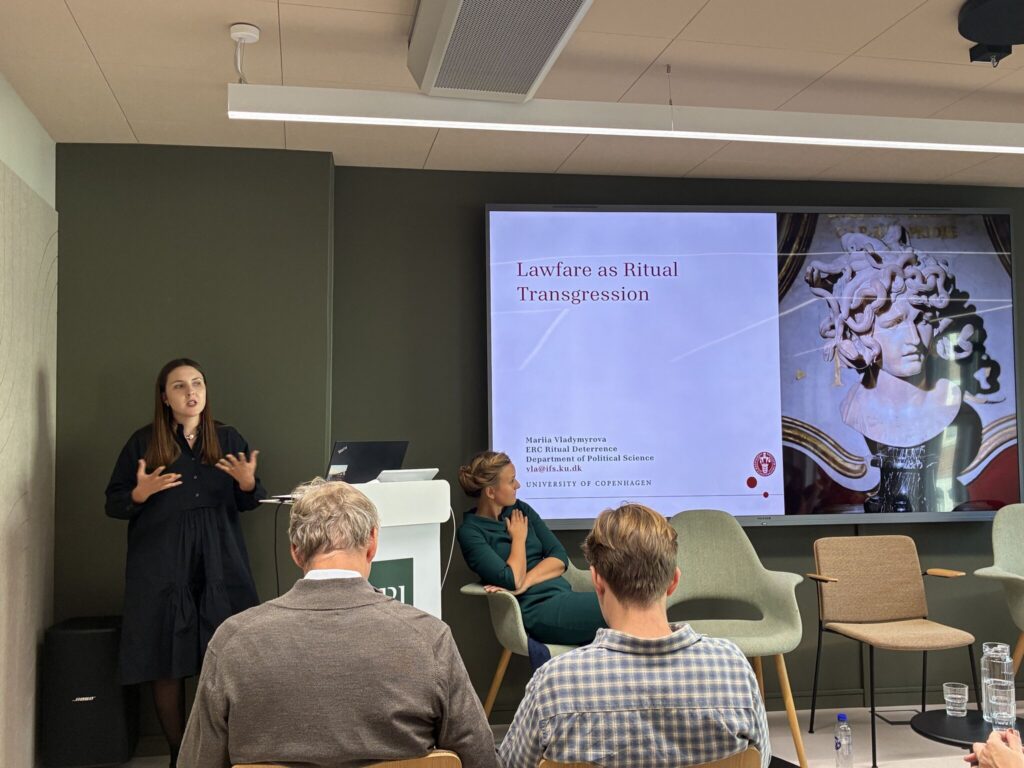
Mariia Vladymyrova presents her work on Russian lawfare in the Arctic at the Law and Security Conference 2026 at the University of Copenhagen

On 27 August Mariia Vladymyrova attended the PhD symposium within the framework of the Law and Security Conference at the Law Faculty, University of Copenhagen. She presented her recent study of the coercive signaling elements embedded in the Russian regime of the Northern Sea Route. This regime provides a framework through which Moscow asserts its dominance in the Arctic and signals resolve and commitment by introducing escalatory threshold without resorting to the overt hostility (and cost) of militarized threats.


Mariia Vladymyrova attends Kiel International Seapower Symposium

On 18–19 June, Mariia attended the Kiel International Seapower Symposium, “How to Defend Europe at the Northern Flank,” and contributed her insights into Russian deterrence activities at sea during the post-conference workshop. She introduced participants to the key findings of her ongoing research on the repertoire of Russian coercive tactics in the grey zone. In particular, her study of Russian lawfare in the High North spoke directly to one of the central questions the symposium posed: what is the opponent seeking to achieve?
The understanding of Russian seapower in the High North too often begins with an assessment of Western vulnerabilities. Yet legal frameworks can serve as early indicators of Russian strategic priorities and adaptation. Mariia urged workshop participants not to overlook their coercive dimension. A state’s legal practices, domestically and internationally, remain an important site deterrence signaling, and therefore should be embedded in NATO’s threat assessments accordingly.


Thomas Fraise and Cameron Hunter at the 2026 BISA Conference in Brighton

Thomas Fraise and Cameron Hunter recently attended the 2026 annual conference of the British International Studies Association in Brighton. They organized a panel on “The elite politics of deterrence” with Sterre van Buuren (University of Glasgow) and Shivani Singh (O.P. Jindal Global University). At this panel, Cameron Hunter presented his research on US-China interaction ritual chains of deterrence, and Thomas Fraise on ontological security and the ritualization of NATO extended nuclear deterrence.

Under the auspices of BISA’s Global Nuclear Order panels, Dr. Hunter also presented his work on “The International Doomsday Machine”, conceptualizing global nuclear arsenals as a single large technical system. Dr. Fraise, for his part, presented his book project on nuclear secrecy in democratic states.

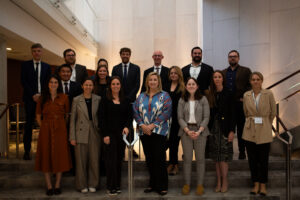
From left to right: Thomas Fraise, Sterre van Buuren, Cameron Hunter, and Shivani Singh

Cameron Hunter and Thomas Fraise present at the UK DAAA Conference

Dr Cameron Hunter and Dr Thomas Fraise recently attended the UK Deterrence and Assurance Academic Alliance (DAAA) conference, hosted by King’s College London. Dr Hunter presented research from his recent publication in the RITUAL DETERRENCE special issue of Global Studies Quarterly, as well as early findings from work in progress. The panel was masterfully chaired by Dr Jan Ruzicka of Aberystwyth University.

Dr Fraise, with co-author Sterre van Buuren, presented their critique of the “nuclear IQ” concept, provoking a spirited debate among the panellists and audience.

Cameron Hunter speaks at UK MoD Outer Space Security and KU PLA Conferences

Last week, Dr Cameron Hunter of the RITUAL DETERRENCE project spoke at two conferences. The first was a closed event sponsored by the UK Ministry of Defence on security in outer space, including deterrence. NATO, China, and to a lesser extent Russia, all utilise space for military purposes in both peace and wartime. Dr Hunter’s previous research was on US-China competition in orbit, with a more recent report on space-based nuclear weapons delivery vehicles. The conference was held under the Chatham House Rule.

The second event was held at Copenhagen University, sponsored by the Danish Ministry of Defence’s Centre for Military Studies. Bringing together international experts, the conference collectively compared the defence budgets of the US and China. Dr Hunter provided comments for Dr Jingdong Yuan’s lecture on the topic, and joined the plenary session at the end of the day to reflect on implications for the future.

Mariia Vladymyrova presents at NUPI IR Theory Conference 2025

22-24 September Mariia Vladymyrova joined the inaugural NUPI IR Theory Conference in Oslo.

Throughout three days and six panels scholars from Europe, North and South America shared their ideas on the relevance and pathways forward for constructivist theory amid increasingly assertive global competition and challenges such as climate change.

Mariia contributed to the panel on “Constructivism and Violence.” She presented an early draft of one of her dissertation projects’ chapters theorizing lawfare as means of ritualized coercive signaling, and looking into Russian approaches to lawfare within the framework of international laws governing peace- and wartime conduct at sea.


Ritual Deterrence Team at the ISA2025

Cameron Hunter and Maria Mälksoo participated in the 66th Annual Convention of the International Studies Association (ISA) in Chicago, US on 2-5 March 2025. Dr Hunter chaired the panel ‘Making Deterrence Possible: Rituals and Narratives in the Study of Deterrence’ and presented his work on interaction ritual chains in US-China nuclear politics therein. He further served as a chair and discussant of the panel on ‘Automated World-Making: Ethics, Culture, and Artificial Intelligence’, and presented a paper on ‘Cynicism and Nationalism in Contemporary Chinese Nuclear Pop Culture’.

Prof. Mälksoo convened a panel ‘Ritual Realms and Repertoires in World Politics’ which brought together a number of contributions for the forthcoming special issue of the project. She presented a paper ‘Deterrence at Arm’s Length: NATO and the Russian War on Ukraine’, and contributed to three roundtables: on ‘The Mnemonic Turn in IR’; ‘Honouring Stefano Guzzini as Global International Relations Section (GIRS) Distinguished Scholar’, and ‘Critical Perspectives on NATO’.

Thomas Fraise, Cameron Hunter and Maria Mälksoo at the ERC NUCLEAR concluding conference at Sciences Po

Cameron Hunter and Maria Mälksoo at CMS China’s Nuclear Force Conference