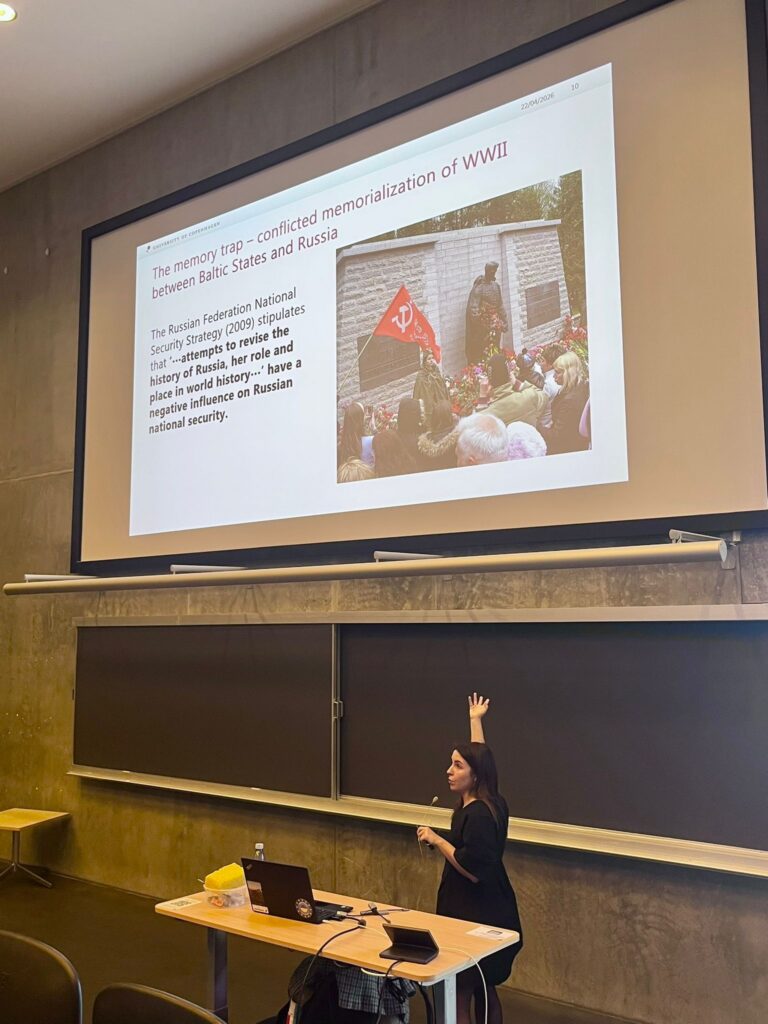
Mariia Vladymyrova delivers a guest lecture at the University of Southern Denmark


Mariia Vladymyrova delivered a guest lecture on Baltic security to students at the University of Southern Denmark. Her talk addressed the gaps in how public and policy discourse currently assesses the region, aiming to reframe the hybrid threat environment in the Baltics not as a standalone phenomenon, but as a symptom of a broader shift in Europe’s political landscape triggered by the Russian assertive restorationism.
Throughout the lecture, Mariia introduced students to the foundational tenets of deterrence and escalation, highlighting how these frameworks offer a useful lens for examining Baltic security from the early 2000s through to the present day. By tracing the evolution of these dynamics between NATO and Russia over two decades, she encouraged students to think critically about the structural drivers behind today’s security challenges in the region. The session sparked engaging discussion and underscored the importance of bringing nuanced, framework-driven analysis into conversations about European security.

Mariia Vladymyrova delivers a lecture at the U.S. Naval War College

Maria Mälksoo’s lecture at the PhD Summer School in Estonia, 28 June 2023

Maria Mälksoo gave an invited lecture ‘What’s Deterrence Got to Do with Ritual? Tales from the Eastern Flank of NATO’ at the PhD Summer School in Economics and Management, Political Science, Law and Public Administration, a partnership between University of Tartu, Tallinn University of Technology, Estonian University of Life Sciences, Estonian Business School, Tallinn University and Bank of Estonia in Pühajärve, Estonia, 27-29 June 2023.

Maria Mälksoo guest lecture at the CEU Invisible University for Ukraine, 30 March 2023

‘NATO and deterrence’

Maria Mälksoo NORMEMO autumn 2022 guest lecture, 10 Nov 2022

This invited lecture at the University of Tromsø investigates how memory laws that regulate the legitimate frames of remembering the past of righteous and perpetrators function as devices of deterrence in states’ (inter)national memory politics. I conceptualize mnemopolitical deterrence and assess the aims and sought effects of various memory laws in the Central and East European space.

Engaging deterrence scholarship in International Security Studies and legal studies, the lecture unfolds and contextualizes the international aims, the projected and (thus far) observable effects of the memory laws that criminalize, discipline and punish the accounts of the past deemed undesirable to a particular state identity in Russia, Poland and Ukraine. I argue that besides defining acceptable and (un)desirable boundaries of political subjectivities, punitive memory laws do performative work by signalling political intent to defend a particular “state’s story” of the past in the international sphere.  

In their distinct ways, the memory laws of Russia, Poland and Ukraine have emerged as international, not just domestic memory-political dissuasion devices in the manifold contestations over the legitimate remembrance and “right” narratives of their respective nation’s role in the Second World War and/or the Holocaust. Mnemopolitical deterrence is illustrative of the ritual logic of action underpinning deterrence practices in state ontological security-seeking.